
Tasks, roles, companies: the three layers of AI disruption
Mario Beck
2026-07-07
Every week someone asks me a version of the same question. "Will AI take my job?" It's a reasonable thing to worry about. It's also the wrong question, because it collapses three separate layers of disruption into one, and the layer where people feel anxious is rarely the layer where the real damage happens.
I want to pull those layers apart. Once you see them separately, a lot of confusing AI-and-work news stops being confusing.
Three layers, one argument
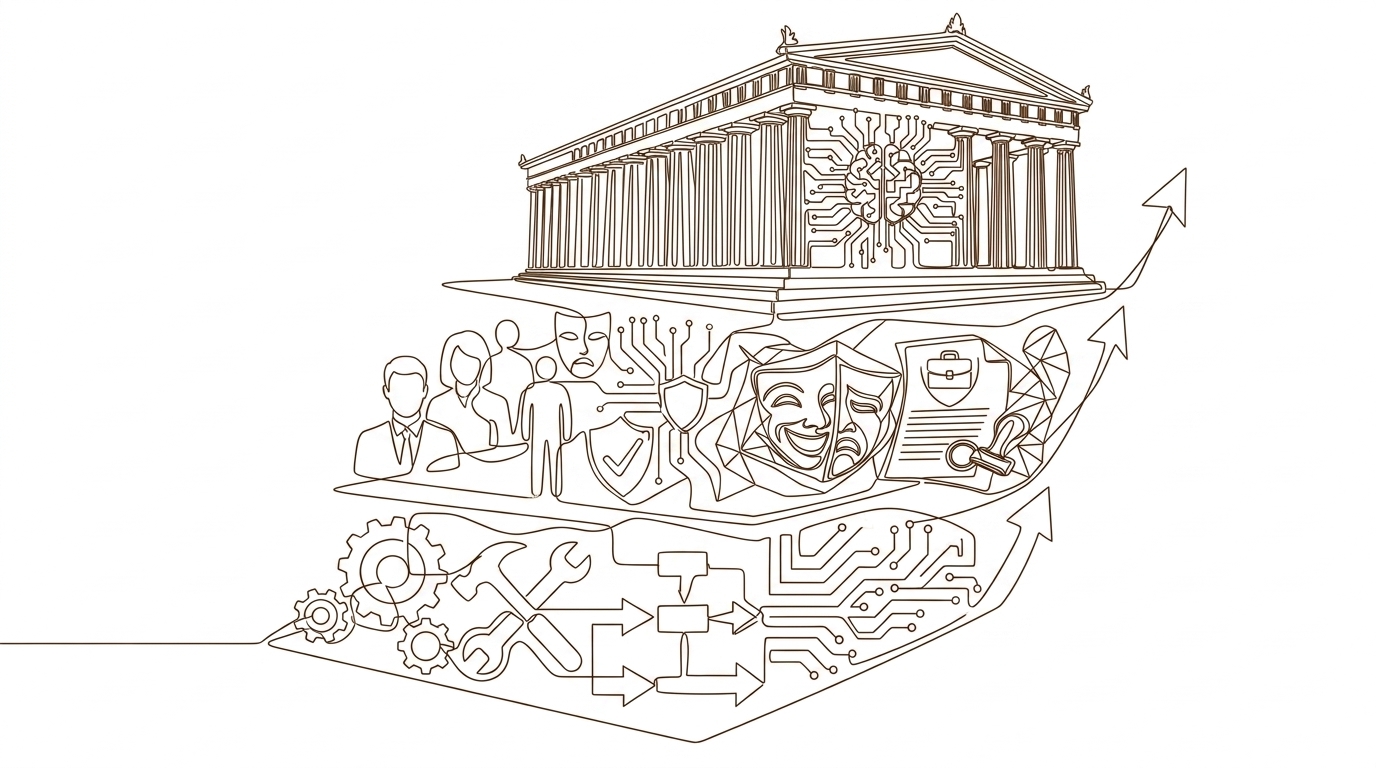
Disruption from AI moves through a stack, not a single event.
Layer 1 is tasks. The individual pieces of work inside a job. Summarize this report. Draft that email. Reconcile these numbers. Tasks are narrow, and a model either handles one or it doesn't.
Layer 2 is roles. The bundle of tasks we give a job title. "Analyst." "Marketing manager." "Paralegal." Roles absorb task-level change by shedding some tasks, picking up new ones, and shifting what the person is actually paid to do.
Layer 3 is companies. The business model. What you sell, who buys it, and why they pay you instead of a competitor or a different way of solving their problem entirely. This is the layer where an entire industry can look healthy right up until it isn't.
Most of the public debate happens entirely inside layer 1, arguing about which tasks a model can do today. Most of the leadership conversation happens at layer 2, debating headcount and role redesign. Almost nobody spends enough time at layer 3, asking whether the model underneath the roles still works. That's the gap this piece is about.
Layer 1: tasks are moving fast, and unevenly
This is the layer generating most of the anxiety, and for good reason. It's the one people experience directly, every day, in their own work.
In "GPTs are GPTs," the 2023 study from OpenAI, OpenResearch, and the University of Pennsylvania, researchers estimated that around 80% of the US workforce could have at least 10% of their work tasks affected by large language models. About 19% of workers could see at least half of their tasks impacted.
Read those two numbers together and the shape of the disruption becomes clear. It's wide. Almost everyone gets touched somewhere. But it's shallow for most people and deep for a much smaller group. Task-level automation isn't a wave that lifts or sinks entire jobs uniformly. It's uneven, task by task, person by person.
This is real, and it deserves attention. It is not, on its own, evidence that a role or a company is in trouble. A role can absorb a lot of task-level change and still exist. A company can automate a mountain of tasks and still be selling something nobody wants next year. Layer 1 tells you almost nothing about layer 3.
Layer 2: roles get reshuffled, not simply deleted
Move up one level and the picture gets messier, and more survivable.
The World Economic Forum's Future of Jobs Report 2025, drawing on data from over a thousand companies across 22 industries and 55 economies, projects 170 million new roles created and 92 million displaced by 2030. Net, that's 78 million new jobs, but the churn underneath is the real story: the equivalent of 22% of today's total employment is expected to turn over. The same report expects close to 40% of the core skills required in existing jobs to change in that window.
Notice what that data is actually saying. It isn't "AI deletes jobs." It's "AI reshuffles what jobs require, and does it fast." Some roles shrink. Some split into narrower specialties. Some get invented. An analyst role from 2023 and an analyst role in 2030 can share a job title and almost nothing else.
This is where most leadership time goes, and it's not wasted time. Redesigning roles around what people are actually needed for, instead of what a job description said five years ago, is legitimate work. But it's also where a lot of companies stop, because role redesign feels like the whole job. It isn't. A company can nail role redesign completely and still be optimizing the wrong business.
Layer 3: companies, where the real risk hides
Here's the layer that doesn't show up in a task-automation survey or a skills report, because it isn't about individual work at all. It's about whether the thing you sell is still the thing people want to buy.
Kodak is the case everyone reaches for, and it earns the reputation. Kodak's global workforce peaked at 145,000 employees in 1988. By the end of 2025, the company reported roughly 3,500 employees.
Here's the part people skip. For most of that decline, individual jobs inside Kodak looked fine. Chemists were still doing chemistry. Marketing managers were still running campaigns. Task by task, role by role, the day-to-day work didn't look broken. The business model did. Film stopped being what people wanted to pay for, and no amount of role redesign inside the film division was going to fix that. The jobs were a lagging indicator. The company was the leading one.
That's the layer 3 pattern to watch for now with AI. A business built on billing for hours of task execution, drafting, formatting, first-pass research, is exposed at this layer even if every individual role inside it looks perfectly staffed. The tasks getting automated aren't the risk. The business model that only made sense when those tasks were expensive is the risk.
Anxiety at layer 1, harm at layer 3
Put the three layers side by side and the mismatch is obvious. The anxiety concentrates at layer 1, because that's where people notice change first, in their own daily tasks. The actual harm concentrates at layer 3, because that's where an entire company can quietly stop making sense while every individual inside it is still doing competent work.
Most leadership conversations get stuck at layer 2, which feels like progress because org charts are changing. But redesigning roles around a business model that's already aging out is rearranging the deck chairs well. It's still the wrong ship.
The uncomfortable version: if a leadership team's entire AI conversation is "which roles do we restructure," they still haven't asked the question that matters. Is the thing we sell, and the way we deliver it, still going to be what the customer wants to pay for?
The layer 3 questions worth asking
A few questions that force the conversation up to where the risk actually lives.
What are customers paying you for today, and will that still be true in three years? If the honest answer is "hours of task execution," that's worth sitting with.
If AI fully automated your current workflow tomorrow, would your org chart still make sense? If the answer is no, task-level automation is currently propping up a structure the business doesn't actually need, and that gap will close on its own timeline, not yours.
Is your last "efficiency" win reinvested in a different offer, or is it just the same offer with fewer people running it? The first is adaptation. The second is a company running the obsolete version slightly cheaper, for now.
None of these questions have a comfortable answer on the first pass. That's the point. Layer 3 is uncomfortable precisely because it's the layer that matters most and gets asked about least.
Where to actually spend your attention
Tasks will keep changing fast, and that's worth tracking. Roles will keep reshuffling, and redesigning them well is real, necessary work. But if that's where the conversation stops, a company can get every layer 1 and layer 2 decision right and still be Kodak in 1988, fully staffed, fully competent, and quietly betting on a model that's already aging out.
The company is the layer nobody schedules a meeting about. It's the one worth scheduling first.
I put together the full three-layer breakdown, with a short worksheet to pressure-test your own business model against it, in this week's newsletter. You can get it here, free.
And if you want to think through where your own company sits on this, my DMs are open.